The child says, ‘That’s the only difference between the dead and those who go away, isn’t it? Those who aren’t dead will return.’ Lucas says, ‘But how do we know they aren’t dead when they’re away?’ ‘We can’t know.’
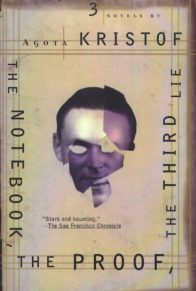
Claus and Lucas are twins. Their new life begins when they are left with their grandmother, the ‘Witch’, in a village in an occupied country. It’s wartime. All their actions are based on survival. They create an exercise regime to toughen up, and record the results in a notebook. Their angelic looks are deceiving. They are implacable, dangerously ethical; their code of life demands that they help a deserter, or blackmail a priest, or come to the aid of a prostitute, or assist in a suicide. What motivates them is a deeply embedded morality of absolute need.
The trilogy—The Notebook (1986), The Proof (1988), and The Third Lie (1991)—follows their stories from the Second World War, through the years of communism and into a fractured Europe. In what could be seen as an allegory of post-war Europe, Claus and Lucas, locked in a tortuous bond, become separated and are isolated in different countries. They yearn to be connected again, but perspectives shift, memories diverge, identity becomes unstable.
Written in Kristof ’s spare, direct prose, The Notebook Trilogy is an exploration of the aftereffects of trauma and of the nature of storytelling. The novels explore truth and lies, shaped by a breathtaking artistic vision that is shocking, fascinating and utterly memorable.
Praise for The Notebook Trilogy:
“Harrowing . . . Kristóf’s sentences are like . . . skeletons, commemorations of indescribable sadness that have been meticulously scrubbed of gore and gristle.”—New Yorker
“The Notebook is a great book, in the absolute.”—Times Literary Supplement
“A stunning, brutal and beautifully written (and translated) book.”—George Szirtes
“I found it profoundly disturbing, incredibly well written, and extraordinarily brave. And the fact that it was written by a woman—it has a startling brutality and ferocity about the style that I find very inspiring.”—Eimear McBride, author of A Girl Is a Half-formed Thing
“If her astonishing first novel contains even a single metaphor, I must have missed it . . . but The Notebook is driven by deep, psychological necessity, not the rules of a literary game. All masterpieces are unique—but perhaps some . . . are more unique than others.”—Peter Goldsworthy, Australian “Books of the Year”
“Closing this chillingly unsentimental novel, I felt that it had contrived to say absolutely everything about the Second World War and its aftermath in Central Europe.”—Sunday Times
“Every now and again you read a book by an unknown author and you know immediately that you are in the company of greatness. That is a rare and precious feeling. It happened to me when, a few years ago, a friend sent me a copy of Ágota Kristóf ’s first novel . . . The utter simplicity of the style, the clarity, the unflinching gaze at a world far removed from any I had experienced and yet curiously familiar—that of a peasant culture on the border of what we take to be Hungary and Germany in the dying moments of World War II—and the deep humanity underlying it all, took my breath away.”—Gabriel Josipovici
“An almost lyrical intensity . . . A fierce and disturbing novel.”—New York Times
“A vision of considerable depth and complexity, a powerful portrait of the nobility and perversity of the human heart.”—Christian Science Monitor
“The Notebook is a transfixing house of horrors.”—New Statesman
“Stark and haunting.”—San Francisco Chronicle
“In its odd, memorable, unique way, The Notebook is a masterpiece.”—Asylum
“A terrific story . . . There is enough kinky sex, perverse violence, and general weirdness to match the best of Henry Miller, Jean Genet, and Jerzy Kosinski.”—Boston Phoenix Literary Supplement
“Just, harsh, strangely moving.”—Observer


 Grove Press
 NEW!
NEW!