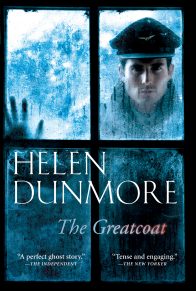
1. Daniel’s covering up of Mary Pascoe’s death is the most obvious lie in the book, but what other lies are told or alluded to? The epigraph to the novel from Kipling reads: “If any question why we died/Tell them, because our fathers lied.” How does the story that follows complicate the notion of placing judgment on one who has lied? To what extent do you think Daniel is accountable for his lie?
2. Compare Daniel’s and Frederick’s characters. How is each defined in terms of both who he is and who he is not? How much of Daniel’s character seems shaped by the outward circumstances he was born into? And Frederick’s? What does each of them value? How does Frederick’s letter add another dimension to his characterization (p. 76)?
3. What do we learn about Daniel’s mother, who she was and how she was seen by others? How has Daniel been shaped by his relationship with her? Look at the first few paragraphs to Chapter 9 (pp. 123-4).
4. What do the chapter epigraphs contribute to the story? How do they relate to the text that follows in each chapter? In some instances (as with Chapter 2), the correspondence is literal, but look at the epigraph to Chapter 11 in relation to the text that follows (p. 160). Most epigraphs are drawn from military manuals, but the epigraphs to Chapters 18, 19, and 21 are drawn from poetry (Coleridge’s The Rime of the Ancient Mariner). What is the effect of this break in the pattern?
5. From the first chapter, images of dirt and soil feature heavily throughout the novel. What are the various roles these images play? What sort of symbolic value do they take on?
6. Common in military parlance, the word enemy appears in the epigraphs to Chapters 9 (p. 123) and 15 (p. 221). Look at the enemies described in those chapters. Do you think the epigraphs might be so chosen to call into question the legitimacy of the term? Daniel feels more enmity toward the French than the Germans (“We hated the French a hundred times worse than the Germans, because they spent their lives dunning us while we were supposedly fighting for them,” p. 176). Does this seem surprising, or appropriate, under the circumstances?
7. How has Daniel’s disadvantaged upbringing better prepared him for life following the war than Felicia’s privileged one prepared her? What skills and habits of mind did he acquire in early life?
8. When Daniel disturbs a toad in the garden, he looks into its eyes and observes: “They are hooded and ancient. They are the kind of eyes that believe in nothing but what they see in front of them, and maybe not always that” (p. 32). Does Daniel look at the world with a toad’s eyes? How has the war affected his ability to believe what he sees? In relation to this, consider Daniel’s avoidance of crowds and his feeling that “every creature is in disguise. Their skin is a veil to hide the intestines and the raw, slimy flesh within” (p. 33).
9. Is there a mystical aspect to this story? Who else besides Daniel seems to see Frederick? Is there a sense in which Daniel’s visions of Frederick are as significant as his interactions with the live Frederick were? Do Daniel’s imaginings affect his actions?
10. How does Dunmore deepen the novel’s exploration of privilege by bringing Felicia’s aspirations into the story? Does being the underdog socioeconomically make Daniel sensitive to the deprivations of others? How is he critical of Felicia?
11. The First World War gave rise to a great body of war poems, arising out of a culture conversant with poetry in which students were required to learn poems by heart. Does this novel serve as an argument for the value of general acquaintance with poems? What role do poems play in the story? A lover of words, accused by Frederick of being a “blowviator” and using too many of them, Daniel thinks “that maybe you had to have too many, to have any chance of ever possessing what you needed, just as you sowed lettuce seed and then thinned out the seedlings” (pp. 94-5). Do you ever wish you had more words—and perhaps also poems—in your arsenal? The writing in this novel is richly descriptive, particularly regarding landscape—do you find the language itself compelling?
12. Coleridge’s Rime of the Ancient Mariner seems to be a touchstone poem for Daniel. While he’s out working in the garden, lines from the poem come to him, and he thinks that the albatross the mariner kills “was not only an albatross. It was the thing without which you can continue to live, but no longer be human” (p. 54). How does the mariner’s predicament relate to Daniel’s own experience? He goes on to muse: “If you kill the albatross, you can never come back to your own country.” Do you agree? Is Daniel still too young to wield a word like never? In addition to war, what other experiences might distance someone so utterly from their former life?
13. When Daniel tells Felicia, “They say that the dead aren’t tied to one place,” a shiver runs through him, and he thinks: “It’s an awful ecstasy, and it feels like the first true thing that has happened this evening” (p. 81). Is facing up to death necessarily truer than the concerns of ordinary life? Do you think extreme experiences can rob people of the ability to involve themselves fully in ordinary life? Later, as he sits by the fire and waits for Felicia to return from the kitchen, Daniel thinks: “This is the afterlife. This is what we dreamed of, in France. Fire, and four walls, dry feet, a belly warm with food” (p. 150). Do you think the act of longing can be fulfilling in itself?
14. How does the class disparity between Daniel and the Dennis family manifest itself? Daniel is keenly sensitive to it, but how do Felicia and Frederick show an awareness of their difference in standing from their friend? Frederick communicates with Daniel by quoting from the stories Daniel has told him from Kim and Great Expectations (pp. 94 and 187-8). The protagonists of those novels, Kim and Pip, are both poor orphans—why do you think their stories appeal to Frederick?
15. How does Daniel react to Frederick’s arrival in his company (Chapter 12)? He introspects, “I didn’t know how to be all the things I was meant to be, to Frederick, to the others, to the war. It brought me back to myself, and I didn’t want that” (p. 180). How are Daniel’s various senses of identity thrown into conflict? Who is he among his fellow soldiers, and who was he before that, alone but for his friendship with Frederick?
16. Twice, Daniel quotes from Matthew Arnold’s “Dover Beach” (pp. 183 and 249), and twice is moved by the line about love, whereas Frederick is more interested in the line about armies. How would you characterize the nature of Daniel’s feelings for Frederick? For Daniel, “[Frederick] was always more real than anyone” (p. 188). What makes others less real to him? Daniel thinks, “We were no use on our own, either of us. If I was ever going to be myself, I needed him” (p. 189). How does Frederick help Daniel to be his fullest self?
17. Frederick, Felicia, and Daniel are all misfits of a sort. In what way is each of them born into a role that doesn’t fit? Does each show signs of being able to transcend that? Do some of Daniel’s attitudes hold him back?
18. “They say the war’s over, but they’re wrong. It went too deep for that. It opened up a crack in time, a crater maybe. Once you fall into it, you can’t get out again” (pp. 271-2). Could this be a summation of what the novel as a whole seeks to illustrate? Bereavement, too, is an experience with an indefinite end. Are there happy experiences that linger as well, and are hard to come out of? What else might open a crack in time?
19. Daniel plays a care-taking role several times throughout the book, and other characters help and care for each other as well. How does the novel explore the hazards and benefits of solitary life versus living in community? How does war change the soldiers’ relationships to each other?
20. In Chapter 5, Daniel has thoughts of drowning himself but regrets that the sea ‘refuses’ to take him and that his own instinct for survival is so strong (p. 58). What has changed by the end of the book? Is it possible that Daniel lied because he felt survivor’s guilt and wanted a reason to be punished, perhaps wanted to die as he feels he should have in the war? In the final paragraphs of the novel, why do you think Frederick appears to Daniel in civilian clothes?
Suggestions for Further Reading:
The Regeneration Trilogy by Pat Barker; Birdsong: A Novel of Love and War by Sebastian Faulks; Good-Bye to All That by Robert Graves; Strange Meeting by Susan Hill; In Parenthesis by David Jones; My Dear I Wanted to Tell You by Louisa Young; The Return of the Soldier by Rebecca West


 Grove Press