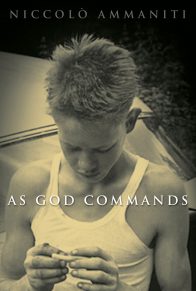
1. Angst-ridden teen Lorenzo Cuni takes center stage in this brief novel as it charts one momentous week in his young life. Begin your discussion of the work by considering how well you got to know him in this short period of time. How appealing a character is he to you? Does your opinion change as the narrative unfurls?
2. While Lorenzo’s self-induced confinement in the family cellar begins with his need to pretend that he is away on a ski vacation with his friends, it grows to become more than that. Talk about the evolution of “Operation Bunker” and what it means to Lorenzo. Does he look forward to his time there? Do you think he has expectations for the week or does he ultimately view it as a means to an end?
3. Consider how the author manages to speak volumes in such a slim text. Look at his language choices to understand how he can say so much in so few words. Talk about the cinematic quality of the text. Did you find the narrative enigmatic at all due to its brevity?
4. How far would you agree that one of the novel’s central themes is authenticity of self? How does this manifest itself in Lorenzo’s life? Consider his constant attempts to hide his true nature to fit in with the people around him. Why is it so debilitating for him? Discuss instances in the novel where other characters hide from themselves or hide themselves from each other.
5. Continue your discussion of this theme and look at the underground cellar in the light of this statement: “On my own I was happy, with the others I always had to pretend” (p. 38). By hiding in the cellar, Lorenzo dupes his parents into thinking that he has achieved normalcy, that he has conformed to everyone else’s expectations. Ironically, what does his time in the cellar allow him to do?
6. Discuss Lorenzo’s relationship with his mother. Do you think that the author presents her as a stereotype, or at least as a universal modern mother? Do you sense underlying criticism in the depiction of Ms. Cuni? How much, if at all, does Lorenzo’s attitude toward his mother’s concerned parenting change during his time underground away from her?
7. In a striking scene Lorenzo witnesses his mother through the eyes of outsiders as they verbally abuse her for her role in a car accident. His response is to faint. What did you take away from this? What do you think the scene said about Lorenzo and his mother?
8. How fair is it to say that Lorenzo’s parents main hope is for their son to be viewed as normal and socially acceptable? Why is this so important to them?
9. With cunning perceptiveness and blatant manipulation Lorenzo knows very well how to play his parents against each other. He tells his mother, “Dad said I have to be independent. That I have to have my own life. That I have to break away from you.” Do you think he has any idea of the truth behind this? Find other examples of his manipulation.
10. Discuss the sense of the absurd throughout the novel, whether it is, for example, the premise of Lorenzo hiding from his parents in their own basement or the scene in which he steals pain medication from his dying grandmother. Find other examples and figure out how the author mines these scenes for their poignant details and creates highly realistic scenarios.
11. “Lorenzo, you’re like a cactus: you grow without bothering anyone, you just need a drop of water and a bit of light” (p. 27). How prescient was the old nanny from Caserta in saying this to Lorenzo? How far would you agree that other people were the problem for young Lorenzo?
12. Consider Lorenzo’s childhood as a whole and find instances where he understands that he needs to fit into society, especially the primal society of the school yard. Talk about the difference between knowing the importance of fitting in and wanting to fit in. How do these differences affect Lorenzo? When do the two ideas meld together and become one and the same for him?
13. Why does Lorenzo choose the history high school instead of the mathematics one. What does this say about him? About his father?
14. The novel opens with a description of the scientific theory of Batesian mimicry in which “a harmless animal species takes advantage of its similarity to a toxic or poisonous species . . . imitating its coloring and behavior.” This classic means of survival among animals is used by Lorenzo with great effectiveness as he adopts the mantra “Imitate the dangerous ones” (p. 37). How is he able to continue this charade with his parents? Does he convince himself? What is his biggest fear during this time of his life?
15. One of the most developed and sympathetic characters in the book is the canasta-playing, Bloody Mary—drinking grandmother. Why do you think Lorenzo likes her so much? What does she represent in the novel?
16. While Lorenzo struggles to survive at school he is struck by Alessia Roncato and her tightly knit group of friends. What does he find so alluring about them—about Alessia especially? Why is this?
17. Lorenzo’s life away from the confines of society is interrupted suddenly by the arrival of Olivia, his half-sister from his father’s previous marriage. Discuss the reasons that Lorenzo is so angry to see her, and reluctant to help her.
18. Consider the way that Lorenzo shows true allegiance to his father when Olivia speaks ill of him, and discuss whether perhaps he grows to learn that the image he has of his father may not be the only one. People are not always as they appear. Does this apply to other people in the novel? His mother?
19. “Something inside me snapped. The giant that had been holding me up against his stone chest had let me go” (p. 110). Talk about this passage and what it means in the narrative as a whole. Why do you think Lorenzo decides to help his sister now, knowing that she is a junkie? To what extent would you say that this is the defining moment in the novel? Why, or why not? How has Lorenzo changed?
20. Talk about the sense of life and hope that springs up in the presence of Olivia and Lorenzo as they begin to appreciate each other as siblings. As damaged individuals. What can they offer each other, and what do they learn from each other? What do you think Olivia’s feelings are for Lorenzo given the hellish life she is living?
21. Would you consider Olivia as an authentic person? She is certainly not trying to please her father but is she hiding from her true self in other ways? What do you think it is about her that inspires Lorenzo so greatly?
22. Olivia and Lorenzo exchange hopeful promises as their week together draws to an end. As a reader is it possible to believe that their dreams will exist in the world beyond the cellar or do you sense that the real world will extinguish them? How far are the promises a young boy’s na’ve wishes taken up by a young woman looking for salvation?
23. Lorenzo undergoes some deep transformations down in the cellar. How hard do you think it is for him to be honest with himself and comprehend the reason for his lie to his mother? Do you think he has rediscovered who he is, or instead has become a different version of himself, an authentic one? Why do you think it is such a revelation to him that he wants to have friends, and have fun? How much of this understanding came from Olivia? How do you think he will survive in the real world outside?
24. Why do you think the author chose to sandwich Lorenzo’s coming of age between the bookends of the Cividale del Friuli chapters from ten years later? What effect do these chapters have on the rest of the novel? Do they change the tone, the central message?
25. When Lorenzo tells a story to his dying grandmother he thinks about the human need for closure. How far would you agree with him that humans crave this sense of ending? In the light of his thoughts discuss the ending of the novel. Would you have preferred an open ending with Lorenzo ready to embrace the world and his sister promising never to touch drugs again? Or were you pleased with the closure of the ending?
26. Ultimately, would you view the novel as tragic? Or as hopeful? Why?


 Black Cat