“The little trouble I give myself, this absurd diary with its lists of pictures, serves no purpose, is only the act of an obsessional neurotic. Counting pennies would do as well.”
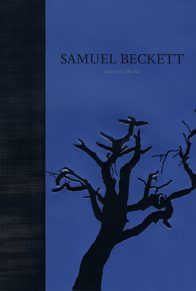
Only once in his life did Samuel Beckett keep a diary of any length, when he took an extended trip through Germany, during the fateful months of September 1936 through April 1937. In his estate were found the six capacious volumes of diaries that he kept on this journey which form the text of German Diaries.
Beckett’s German Diaries give insight on the development of his textual aesthetics and views on literature and visual art. They also show his motives for taking this extraordinary journey and are imbued with a historic significance thanks to the clear eye that Beckett, even as a thirty-year-old, was able to cast on everyday life of the early years of Nazi Germany.
Beckett encounters the effects of Nazi cultural policy in his visits to museum depots to see paintings removed from display and develops his understanding of the cultural boycott through conversations with artists and collectors. Equally engaging are his detailed observations about the Nazi character and the troubling acts of antisemitism he witnesses. The text is rich in intimate details—Beckett’s search for less dingy lodgings, his joy in learning German, his attempt to find food and drink that is cheap, plentiful, and perhaps even good.
Taken together, the diaries illuminate a singular personality, as well as the formation of a young artist. With extensive commentary by editors Mark Nixon and Oliver Lubrich, German Diaries is a significant and unique addition to Beckett’s oeuvre and a landmark cultural moment.
Praise for German Diaries:
“The German Diaries give us Beckett in the larval stage, a chrysalis in crisis . . . The book is a treasure trove . . . Beckett shows himself to be an extraordinarily sensitive seismographer of the Nazification of everyday life. The publication of the German Diaries, a milestone if not a sensation, helps us situate a seemingly timeless body of work in an all-too-specific time.”—The Times Literary Supplement
Praise for Samuel Beckett:
“He made sense when nothing else did.”—Jim Harrison
“Beckett’s writings constitute probably the most significant body of work produced by a twentieth-century author, in that they’re taken to signify the greatest number of things. Beckett is the most prestigious writer around.”—The New Yorker
“Poet, novelist, short-story writer, playwright, translator, and critic, Samuel Beckett created one of the most brilliant and enduring bodies of work in twentieth-century literature . . . Open anywhere and begin reading. It is an experience unequaled anywhere in the universe of words.”—Paul Auster
“[Beckett] never set out to be a revolutionary but rather to investigate the particular advantages of theater for his characteristic meditations on being, dubious presence, seriocomic desolation and the artistic imperative to ‘fail again, fail better.’ In the process, though, he ended up turning the theater world—famously liberal politically yet notoriously conservative regarding received forms—on its head.”—The New York Times
“His exuberance gleams, and it is his exuberance—even the exuberance of his despair—that endears an author to us, far more even than his message.”—Arthur Miller
“I could show you a Beckett sentence as elegant in its implications as the binomial theorem, and another as economically sphinx-like as the square root of minus one, and another, on trees in the night, for which half of Wordsworth would seem a fair exchange. The declarative sentence, he makes you suppose, is perhaps man’s highest achievement, as absolute as the egg was for Brancusi.”—The New York Times Book Review
“The simplicity, the beauty, yes, and the terror of the words shook me as little had before or has since. And the man’s vision of the world, his painfully honest portrayal thereof, his anti-illusionist stance. And the humor; God, the humor.”—Richard Seaver


 Grove Press
 NEW!