FRAUD ALERT: Professional scammers are impersonating Grove Atlantic staff, offering contracts under false pretenses. If you are contacted, or need to verify any communication, please call us at 212-614-7840.

News Room

My Mother is a Kathak Dancer by Eshani Surya
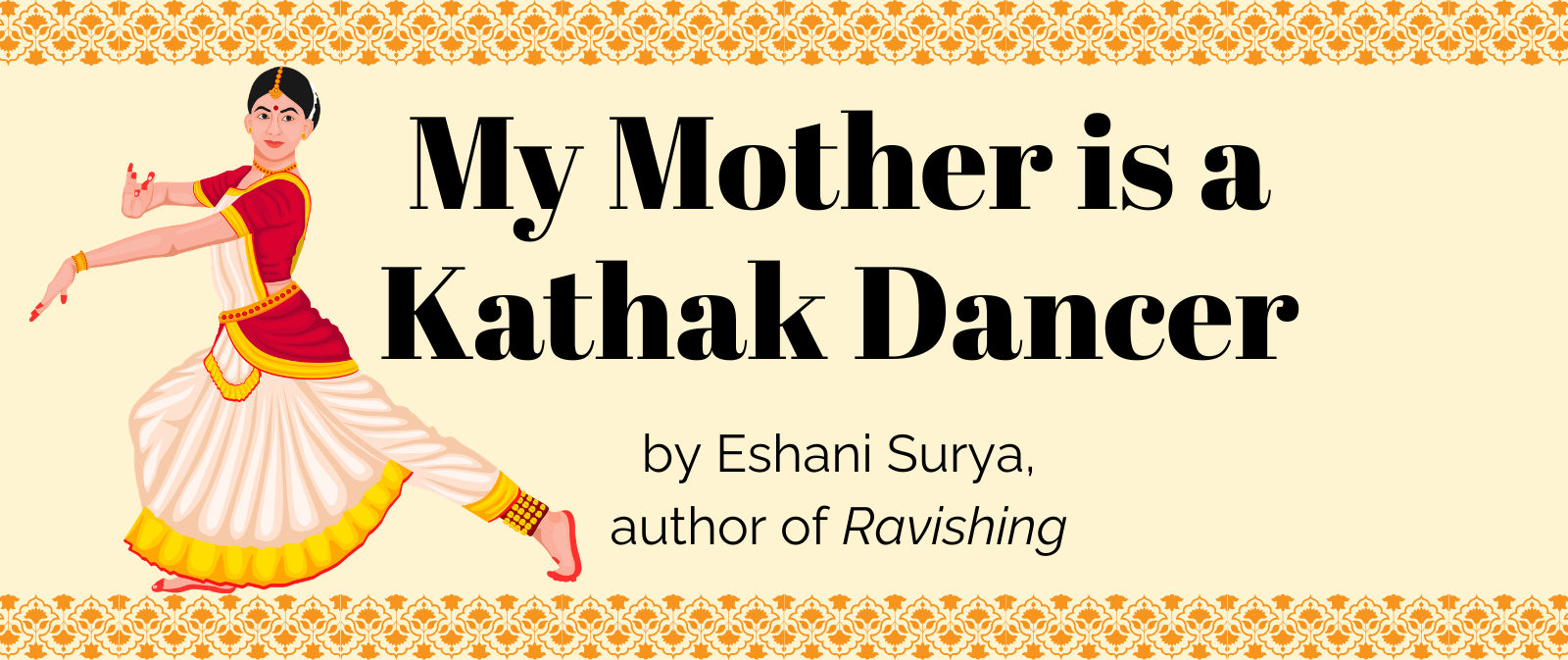
My favorite part of my mother’s bedroom was her collection of cassette tapes, stacked in a bookcase. She also kept the tapes packed away in shoeboxes in the closet, and in the glove compartment of our car, and haphazardly by the dual cassette/CD audio system that sat stocky in our living room despite going out of style years ago. Music makes my mother, who is a Kathak dancer, tick, and I swear that her mind is an ever-present soundtrack that steals her attention at all times. My mind isn’t quite the same—but it too has been shaped by the Kathak backing tracks my mother listened to all through my childhood, and these days I’m acutely aware that her relationship with music and dance is what allowed me to have a sincere connection with my Indian heritage.
Growing up, I had a sense of what was expected of me and my South Asianness by my family, my community, and the larger American public. Sometimes I invited my friends to parties and giggled at them when they couldn’t handle the spice in the food. Sometimes I rubbed off my tilak after a puja, in case my cousins and I took photos in our salwaar kurtas for Facebook—we wanted to look exotic, but not too weird to our white peers. Sometimes I said “we” in history class when talking about white colonizers in the seventeenth century, because that’s what everyone else was saying. I maintained a sense of performance.
But engaging with Kathak and Indian music didn’t require me to enact any kind of identity; instead, it asked me to be no one but curious. Partially, this was because when I turned away from Kathak—telling my mother I didn’t want to learn it, despite her teaching the art form to over fifty girls a week—she allowed it. She even said she was glad, because she was worried about how to be both a teacher and mother. She hadn’t realized that she would play this dual role anyway. Because once I was allowed to choose my way of being interested, I immersed myself wholly.
When my mother shared her cassettes with me, I was always taken in, both by the sounds and by the discussions we would have about Indian classical musical theory after. I learned about raga, tala, rasa, bhava. I learned about the methodology of artistic tutorship in India, in the form of guru-shishya principles. I learned about the importance of improvisation. And I gained my own understanding of Indian music and dance, as spiritual expression, showing that the divine lives in the awareness and acceptance of the world as multitude. This appealed to me, I imagine, as a diaspora kid, who was underpinned by the traditional, transformed by the modern.
These days, as I have grown older, I am often struck by this idea of multitude. What does it mean for me to work a nine-to-five job while my country bombs cities? What does it mean for there to be death at that scale that can so easily be forgotten? And on a smaller, more solipsistic level, what does it mean that there was once a version of me in the world who did not imagine life as it is now—what does it mean that deep inside me, she might still exist? When I say there is divinity in the acceptance of the world as multitude, I do not mean to suggest that we accept harm to others or ourselves. But I do suggest that we see the universe as a space of many truths, colliding.
I remember, now, the cassettes. The way my mother and I wound them back and listened again. The way we sometimes pulled the tape out of them, and had to carefully feed it back in. The cassettes were delicate, but handling them with a shared gentleness made listening to them all the more intimate. When we were there, choosing which one to listen to, fixing the jams that inevitably happened, my mother and I became one, even as we were two.
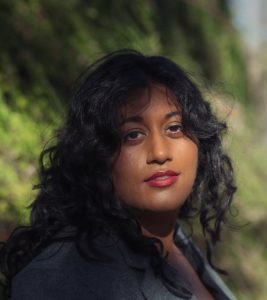 Eshani Surya is a chronically ill South Asian writer living in Philadelphia. She holds an MFA from the University of Arizona, and is a 2022 Asian Women Writer’s Workshop mentee, a 2022 Kenyon Review Writer’s Workshop scholarship recipient, and a 2021 Mae Fellowship recipient. Ravishing is her first book.