FRAUD ALERT: Professional scammers are impersonating Grove Atlantic staff, offering contracts under false pretenses. If you are contacted, or need to verify any communication, please call us at 212-614-7840.

News Room

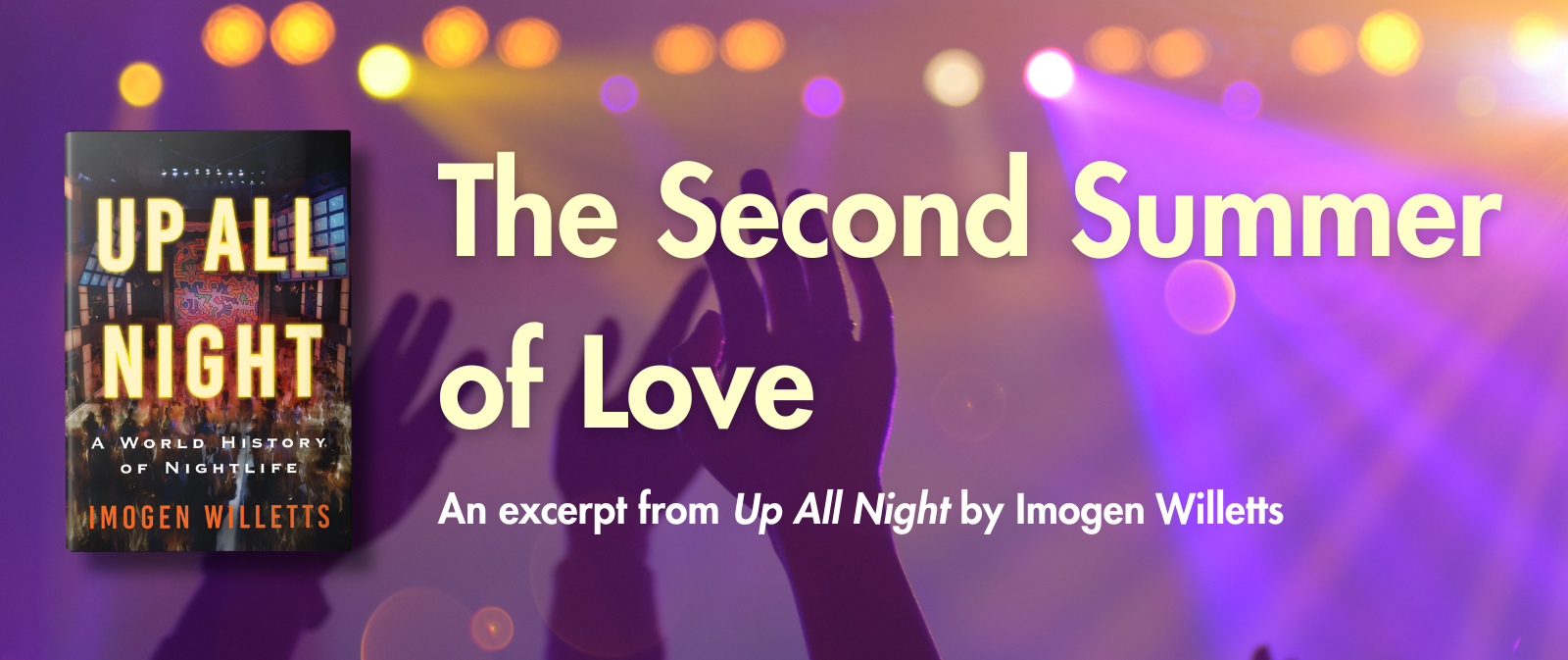
Up All Night – The Second Summer of Love
Supposedly, The Wizard of Oz is really about a troupe of Midwesterners discovering California. The story follows a cast of characters as they venture from an oppressive place into a magical, technicolour dreamland. A very similar sensory awakening was experienced by a group of four British DJs – Paul Oakenfold, Danny Rampling, Nicky Holloway and Johnny Walker – who, in the summer of 1987, went on holiday to Ibiza to celebrate Oakenfold’s twenty-fourth birthday with their Ibiza-based DJ friend Trevor Fung.
They left behind Thatcher’s drab Britain of strikes, youth unemployment, austerity, and cultural conservatism. The inexorable decline of the country’s once-mighty industrial heartlands didn’t exactly inspire much hope for the future. Ibiza was their Emerald City. For decades, this tiny island had been a haven for Spanish hippies, gay people and artists fleeing the grip of Franco’s fascism. Once his regime collapsed in 1975, musicians flocked to Ibiza’s free-spirited nightclubs. The bullring hosted performances by Bob Marley and Eric Clapton.
By the eighties, the island still had a camp and bohemian edge. But it was starting to attract the first wave of sun-seeking British tourists. Their first port of call was Amnesia, a vast tropical open-air disco bedecked with palm trees, fountains, outdoor beds and billowing canopies. A kaleidoscope of lasers pulsated across the starry night sky. At the DJ decks was Alfredo Fiorito, a journalist from Argentina who’d emigrated to Ibiza back in the seventies to escape his country’s military coup. He quickly learnt how to mix records and, despite his lack of experience, began working in clubs. Alfredo had an instinctive knack for long-form, vibe-shifting DJ sets, basically inventing the Balearic sound now associated with Ibiza.
Amnesia couldn’t have been more different to a UK nightclub. Back home, the scene was tired. Artist Adi Dowling from Coventry explained: ‘At that time to go to a nightclub you had to wear a shirt, tie, trousers and shoes and they played pop music till 02:00.’ Nicky Holloway was similarly unenthused: ‘We were all fed up with these posey clubs where people stood around with nothing to do.’ The music was bland and uninspired. Brawls regularly broke out: ‘If you came to Leeds and you went to an event in Manchester or Liverpool you’d get your head kicked in,’ remembers Dave Beer, the Back to Basics promoter. Aggression, posturing, uninspiring music and football hooliganism – going out in the UK back then was grim.
‘But at Amnesia you had seven thousand people dancing to Cyndi Lauper. Total freedom,’ says Oakenfold. It wasn’t just the paradisiacal setting, the holiday vibes and warm air. The five men tried ecstasy for the first time and they were completely off their faces. ‘The whole thing made sense,’ Holloway mused: ‘Alfredo was playing Trax and DJ International next to Kate Bush and Queen, all the white English acts we’d turn our noses up at. But on E, it all made sense.’
Those Amnesia nights had a profound effect on the young men, almost a spiritual awakening. ‘We’d found the Holy Grail,’ said Oakenfold. But they weren’t content with simply leaving their idyllic holiday nights behind. They wanted to bring some of the Amnesia magic back to London. Little did they know, they were about to ignite an unprecedented and highly controversial youth movement, changing nightlife for decades to come.
This was an excerpt of Imogen Willetts’ recently published book Up All Night: A World History of Nightlife from her chapter “Interlude: The Second Summer of Love,” which can be found on pages 273-275.