FRAUD ALERT: Professional scammers are impersonating Grove Atlantic staff, offering contracts under false pretenses. If you are contacted, or need to verify any communication, please call us at 212-614-7840.

News Room

Beast in the Machine by Lauren Acampora
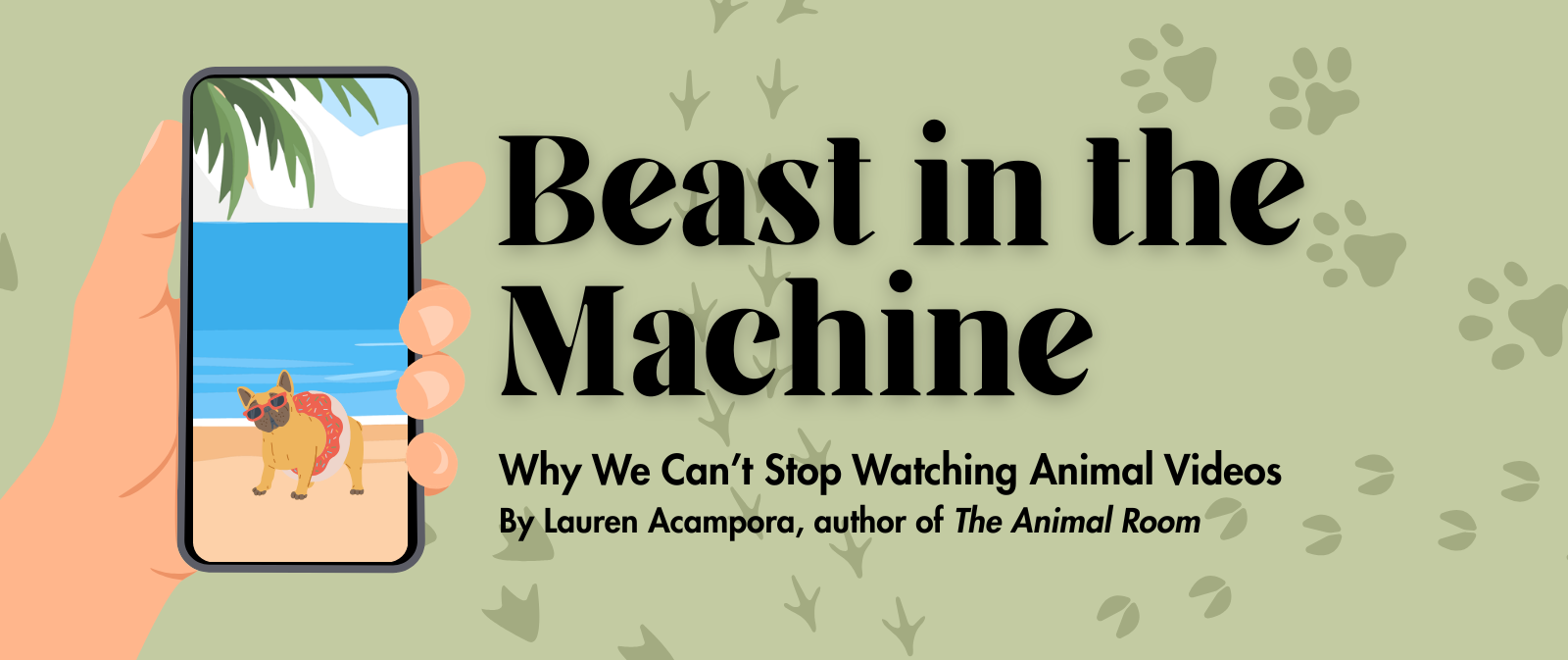
We Rate Dogs. Cooking with Beagles. Dogs Hall of Fame. It may not be what Steve Jobs built the iPhone to do, but it’s what mine does best. After spending the whole day toggling from computer to phone, email to texts to social media, when I’m ready to finally unplug and unwind with a book, I instead find myself looking at a screen again, watching animal videos. I’m powerless against the algorithm’s offerings of raccoons, pandas, hedgehogs, baby elephants—but mostly, it’s the dogs that get me. I surrender to an endless scroll of dogs riding buses and stealing food. Dogs taking baths and avoiding baths. Puppies tumbling in snow and mud and fields of flowers.
My book lies neglected, but I can’t stop watching dog videos. And neither can you. Chances are you’re one of the seven and a half million followers of The Dogist, or the four million followers of Tucker the Golden Retriever. Or, if you’re of the feline persuasion, you may be among the nearly thirteen million followers of Cats of Instagram. Otherwise, you’re probably into the alternative species on offer with Jay Brewer’s Prehistoric Pets, Juniper Wildlife Refuge, or Jill the Squirrel.
Anyone who owns a device with a Wi-Fi connection watches them occasionally, if not primarily. To fact check this, I asked AI. The little professor in my Google search bar told me that, yes, watching animal videos on social media is a near-universal phenomenon, even more so than pornography. “Watching animal videos on social media is extremely common and constitutes one of the most popular content genres online. Research indicates that approximately 98.5% of social media users have already viewed animal videos on platforms such as Instagram, TikTok, and YouTube.” Well, yes, of course they have. The animals are adorable, and entrancing. Their lack of self-consciousness, in direct contrast with our own anxious preening for the camera, is irresistible. They’re unaware of being filmed, indifferent to being watched by millions of people, oblivious to the existence of technology itself. It’s indescribably refreshing to watch creatures through the portal of our screens, simply existing in their worlds.
But I also think there’s more to it, something deeper at play that explains our utter helplessness in the face of Instagram animal reels, some truth about the human condition at this juncture in history. Beyond social media, there’s a wider cultural fascination with animals, from the preponderance of books and shows like Remarkably Bright Creatures, My Octopus Teacher, and Tiger King, to the pop appropriation of indigenous “spirit animals,” and even the advent of therianthropy, the bizarre but earnest belief that one is at least in part a nonhuman animal. This is not to mention the new ubiquity of emotional support animals, as evidenced by the startling number of dogs I saw trotting through the airport on my trip to Florida last week. Yes, everyone was looking at a phone, but they were also walking dogs. It all seems to suggest that, as our lives are increasingly mediated by screens, we may feel a concurrent urge to connect with other living creatures.
This yearning for communion with animals could be indicative of a desire to rewind to a simpler, more natural state. We hold powerful technological miracles in our hands, the apex of human ingenuity. On my Florida trip, my pocket genie provided me with the exact square footage of the beach upon which I sat, and a list of shark species that might account for the dark shape I saw a little too close in the shallow gulf waters. Before this, we’d been content to just not know. Now we’re privileged—but also cursed—to know everything we do and don’t want to know. It’s too much for our systems to process, as evidenced by skyrocketing rates of anxiety and depression. We’ve swapped our Edenic ignorance for a bid at godlike omniscience.
And here, perhaps, is a clue to our animal fixation. When it comes to our comprehension, animals are exempt. Unlike chatbot companions, they lack language. We can’t read or hear what they’re thinking; their inner worlds remain a closed door. When we contemplate a nonhuman creature, we enter an ancient state of not-knowing. Beholding an animal thrusts us back to an earlier state of being, the state of our ancestors who encountered animals in the rawest, most immediate way. We still gasp when we see an animal loose in the wild, whether it’s a fox cutting across the front yard, a black bear climbing a distant ridge in the nature preserve, a coyote darting over a suburban street, or a nameless shark gliding past our feet. We feel the sheer surprise and enchantment that ancestral man might have felt when he stumbled across a creature unfettered —buffalo, jaguar, or hawk—with opaque mind and instincts, an independent will. We feel the same primordial wonder that inspired paleolithic humans to create the first works of art: herds of cattle on cave walls, snakes and owls on cliffsides. From the dawn of time, we’ve gathered around depictions of animals to tell stories and understand the world.
Encountering wildness still touches something deep and familiar in us. When we come across animals in real life, outside of a machine, we’re reminded that we’re animals, too—corporeal, mortal, at the mercy of instincts and needs. Touching a real live animal, even just looking at one, is proven to affect us chemically. It releases the “love” hormone oxytocin, in human and animal both. This attachment is deeply somatic, occurring on a level beneath the awareness of our sapien brains. Despite our complex minds and language, we understand on a deep level that we have more in common with a kangaroo than with Claude. We suspect we could still be wild if we wanted to be. We could turn away from civilization, set down our tools, and bound into the forest with the deer. We could live at one with Nature again, in that pure prelapsarian state.
Animal videos are the new cave art. They’re our society’s way of coming together in celebration of our fellow travelers, something we can all agree on and appreciate. I show my favorite dog videos to my family and friends, and we laugh until our stomachs hurt. It’s the biggest joy my phone brings, this flood of shared endorphins. And, of course, when I finally put my phone down guiltily and go to my own real dog lying a few feet away, an even greater joy rushes through me. I scritch his ears and give him belly rubs. I feel the warmth of his body, the oils of his fur. When I look into his bright brown eyes and he looks back, when he thumps his tail, I can’t know exactly what he’s thinking. But I can feel what he’s feeling, and he and I can share the experience of being alive together in this moment. And just like that, the problems of the day, the suffering of the world, the whole trial of being human, falls away.
 Lauren Acampora is the author of The Animal Room, The Hundred Waters, The Paper Wasp, and The Wonder Garden. Her work has won or been nominated for the GLCA New Writers Award, the Center for Fiction’s First Novel Prize, the Story Prize, and the New England Book Award, and she’s been named an Artist Fellow in Fiction by the New York Foundation for the Arts. Her writing has appeared in publications including The Paris Review, One Story, and The New York Times Book Review and has been anthologized in The Best American Short Stories.